
Introduction
If you’ve been sofa shopping recently — online or in a showroom — you’ve almost certainly come across the terms latex foam and regular foam. Most of the time they’re used without any real explanation.
The foam inside your sofa determines 70% of how it feels in year one — and almost everything about how it feels in year five. This guide gives you the honest, practical comparison you deserve, written specifically for Indian buyers dealing with Indian weather, Indian homes, and decisions that need to hold up for a decade or more.
What Exactly Is Latex Foam?
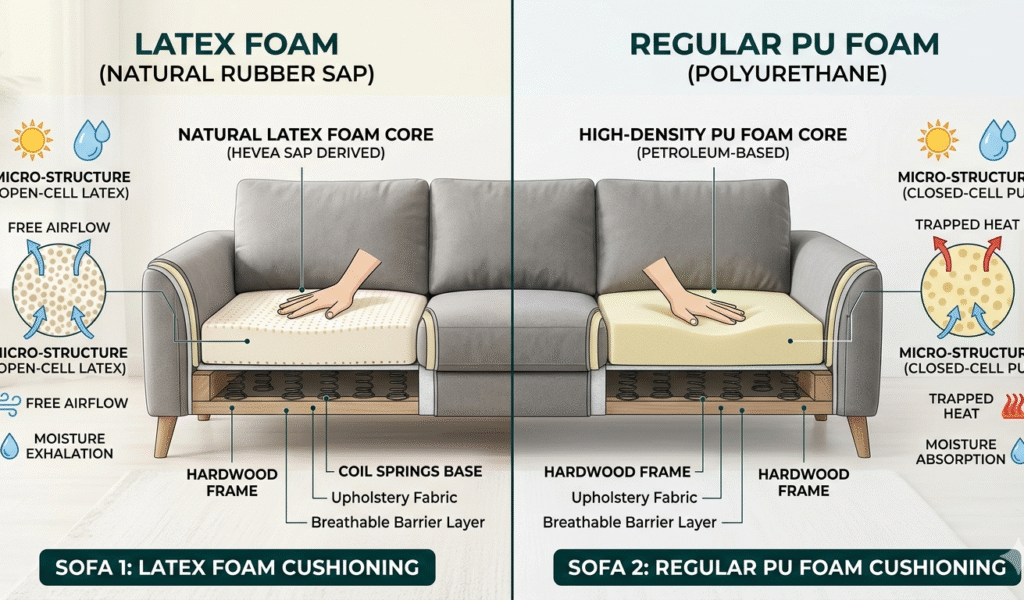
Latex foam is derived from the sap of the rubber tree (Hevea brasiliensis), common in Kerala, Karnataka, and Tamil Nadu. The sap is whipped into a froth and baked into an open-cell structure that is naturally elastic, breathable, and highly resilient. While natural latex is 100% sap-based, blended latex mixes in synthetic additives to manage costs while retaining bounce-back and longevity.
What Is Regular (Polyurethane) Foam?
Regular foam (PU foam) is a petroleum-based synthetic material and the most common foam in Indian furniture. Quality varies from low-density variants that sag quickly to High-Resilience (HR) grades. Most retail sofas in India use medium-density PU foam (28–35 kg/m³), which often shows visible sagging within 1–2 years of daily use.
Why India’s Climate Makes This Decision Critical
- Humidity: Coastal and South Indian cities regularly see humidity above 70–85%, which accelerates degradation in regular PU foam.
- Heat: Summer temperatures in North India can exceed 42°C; foam that traps heat becomes uncomfortable for extended sitting.
- Breathability: Latex foam’s open-cell structure allows air to circulate freely and moisture to escape, reducing mould and odour risk.
- Usage: Indian households typically use sofas more intensively; daily use by multiple family members over 10+ years is the norm.
Upfront Cost vs. 10-Year Value
A regular PU foam sofa may cost ₹35,000 initially, but with foam replacements and reupholstery, the 10-year total can reach ₹55,000–₹65,000. A latex foam sofa typically costs ₹48,000–₹65,000 upfront but often requires no replacements or reupholstery over the same decade, making it a better long-term value.
Frequently Asked Questions
Q: Is latex foam good for back support?
A: Yes. Latex foam offers excellent back support due to its natural resilience — it pushes back evenly against body weight, maintaining spinal alignment.
Q: Does latex foam stay cool in India’s heat?
A: Yes. Its open-cell structure is significantly more breathable than regular closed-cell PU foam, which is noticeable during extended sitting in Indian summers.
Q: Which foam is best for a sofa in Bangalore?
A: Given Bangalore’s persistent monsoon humidity (60–75%), latex foam is the better choice for a 15+ year investment and best comfort. HR PU foam is a strong, more affordable second option.
Q: Does Sofenzi use Latex or HR Foams in all sofas in Bangalore?
A: Sofenzi makes latex and HR Foams as an upgrade. The costing mentioned in site is for Branded PU foams. Sofenzi suggests Latex or HR Foams for people who need high quality and fine with the initial investment. This upgrade is done at additional cost. If you are interested in such build quality you can connect with Sofenzi on Whatsapp 9901126909